
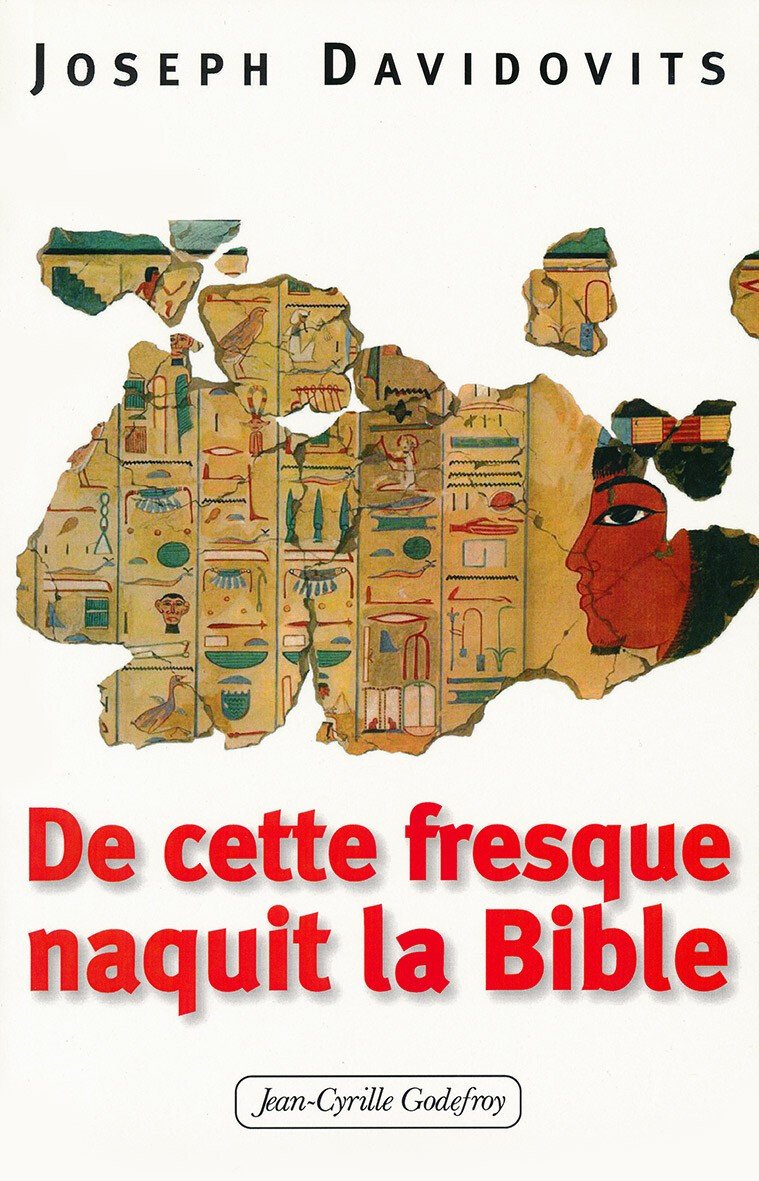
De cette fresque naquit la Bible

author J DAVIDOVITS ISBN : 9782865532162
With this written trace dating from 1350 BC, the author proves that “from this fresco the Bible was born” and reveals the historical personality of the Patriarch Joseph. He shows that if Hebrew artisans were Egyptians, the priests of this Memorial Temple of Amenhotep, son of Hapu were of Semitic ancestry.

In 1935, two French Egyptologists discovered a fresco in the memorial temple of Amenhotep in Karnak. 75 years later, Joseph Davidovits noticed that the text of this fresco reappears word for word in chapter 41 of the Book of Genesis, describing the installation of Joseph by the Pharaoh to command [...] Read more

R$ 170,3710
Réf: 261746
qty
in stockmore than: stock copy(ies), Delivery between 2 and 4 days

Author J DAVIDOVITS

Editor JEAN CYRILLE GODEFROY

Dimensions 15,5 x 24

Number of pages 256

Type of book Broché

Language French

ISBN 9782865532162

Description
In 1935, two French Egyptologists discovered a fresco in the memorial temple of Amenhotep in Karnak. 75 years later, Joseph Davidovits noticed that the text of this fresco reappears word for word in chapter 41 of the Book of Genesis, describing the installation of Joseph by the Pharaoh to command Egypt. This fresco thus appeared to be the first written trace of the Bible. For the author, the patriarch Joseph and the scribe Amenhotep, son of Hapu are one and the same person, and he demonstrates it in this book by re-examining a number of archaeological documents that he repositions within this new context. He also notices that it is possible to retrace the life of Joseph by studying the statues dedicated to Amenhotep, the eminent scribe of the court of Amenhotep III, the great scholar and architect to whom we owe the Colossi of Memnon. Another troubling fact: the similarities between the religion of the clan of Amenhotep and that of the Hebrews. In fact the clan of Amenhotep sought to impose monotheism in Egypt with the Pharaoh Akhenaten. On his death, its members were chased out of Egypt and went into Exile in Judea... in the same way as Moses and the Hebrews experienced exodus. By following the history of the memorial temple of Amenhotep, son of Hapu from 1356 to 1075 BC, Joseph Davidovits discovered the true character of Moses and the causes of the Exodus; he explains that it was actually among the Hebrews that Moses took refuge. A rigorous and thoroughly researched book.
Table of contents


• Le patriarche Joseph est le savant-scribe Amenophis Fils de Hapou : La fin du consensus entre l’égyptologie et l’archéologie biblique – La fresque du temple d’Amenophis Fils de Hapou . Âgé de 3400 ans, c’est le document le plus ancien recopié dans la Bible – Joseph est Amenophis Fils de Hapou. Pharaon surnomma Joseph çaphênath-Panéah – La vie de Joseph-Amenophis d’après les statues dédiées à Amenophis Fils de Hapou – Quand le fameux Amenophis Fils de Hapou devient Houy Fils de Hapou et Joseph Fils de Jacob - La redécouverte de la pierre agglomérée par le savant et alchimiste Amenophis. Les Colosses de Memmon. Les greniers de Joseph – Les membres du clan de Joseph-Amenophis Fils de Hapou – La vie dans le temple mémorial de Joseph-Amenophis 1356 av. J.-C. à 1075 av. J.-C. – Au temps d’Akhenaton. Le maire-gouverneur Abdi-Heba de Jérusalem et le Vizir Abdi-El de Memphis. L’exil des notables.

• Pour une interprétation rigoureuse et scientifique des vestiges archéologies et technologiques. Le peuple iisii-r-iar, ceux exilés à cause de la faute : Les citernes de Jérusalem – Merneptah : stèle d’Israël (1207 av. J.-C.). Les exilés iisii-r-iar. Le peuplement des Hautes Terres de Canaan du XIVe au XIIIe siècle av. J.-C.

• Moïse et l’Exode : Moïse et l’Exode dans le contexte historique – La fuite de Moïse vers Madian – Les causes de l’Exode. La persécution des prêtres du temple de Joseph-Amenophis – Les forçats de l’agglomération – L’Exode conduit par Moïse vers 1060 av. J.-C. – Les liens entre Joseph et Moïse dans le récit biblique sont masqués par des idées reçues.

• L’autel en pierre du miracle. La Loi de Moïse et le Temple de Jérusalem. Les Hébreux et les Arabes : L’autel en pierre du miracle. La Loi de Moïse et le Temple de Jérusalem – Israël et Juda – Les Hébreux et les Arabes.

Customer review

You bought this product ? Share your impressions.
(Only customers who ordered the item can leave a review.)

Customer Question

Partager cette page