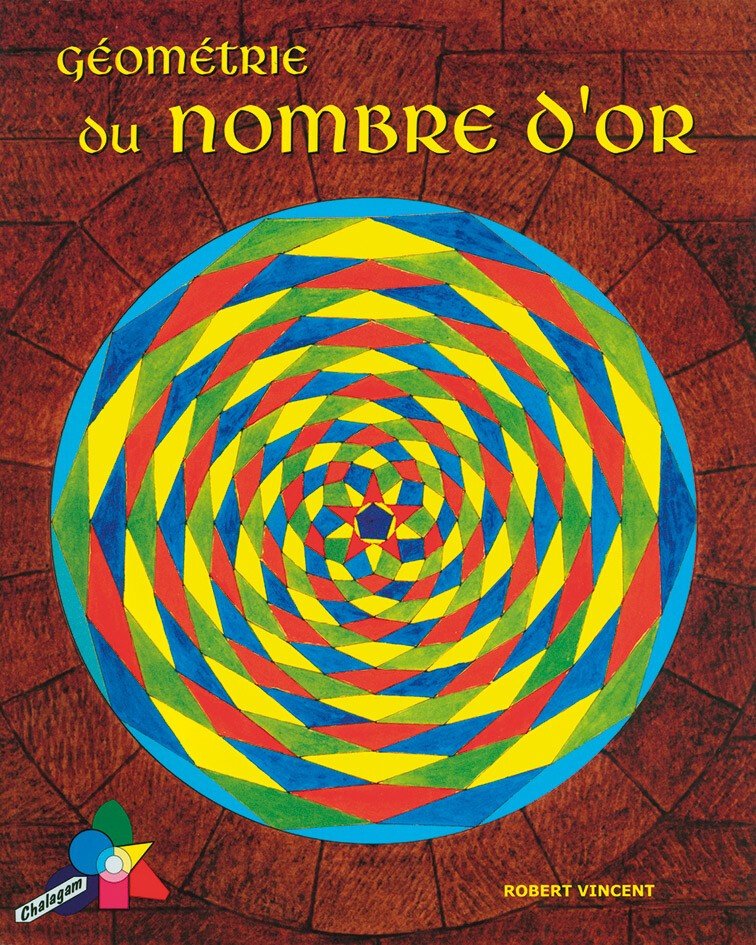
Géométrie du nombre d’or

author ROBERT VINCENT

A worthwhile approach for consideration of architecture and its derived harmony

With the aid of a simple piece of rope along which a knot was tied after every cubit (approximately 52cm, from the elbow to the fingertips), the ancient cathedral builders left their mark on the ground: circular arcs, straight lines, perpendicular lines, mandorlas, spirals and other wonderful [...] Read more

R$ 113,8203
Réf: 020424
qty
in stockmore than: stock copy(ies), Delivery between 2 and 4 days

Author ROBERT VINCENT

Editor CLIP EDITIONS

Dimensions 21 x 26

Number of pages 127

Type of book Broché

Language French

Book format 21 x 26 cm

Description

With the aid of a simple piece of rope along which a knot was tied after every cubit (approximately 52cm, from the elbow to the fingertips), the ancient cathedral builders left their mark on the ground: circular arcs, straight lines, perpendicular lines, mandorlas, spirals and other wonderful outlines to define and position architecture and its decor. This rope was also used to determine the ideal proportions which would make constructions more beautiful and moving. It is only with the ruler and compass, which replaced the rope, that Robert Vincent reveals the secrets of these builders, as much through the art of the outline as its use according to the divine proportions of the golden number. These outlines, which are thrilling to recreate yourself, do not require any mathematical knowledge, for the young they are a source of enjoyment and imagination, they lead us into a universe of emblematic figures and that of the golden number through human endeavour, from the pyramid of Khufu to that of the Louvre by Le Corbusier, the Tarot of Marseille or the official ball used in football. The author then offers us a number of previously unseen geometric curiosities and others such as the duplication of the cube or the quadrature of the circle (with the square of Mercury or Leonardo de Vinci’s canon of proportion), which bring them within our reach! TABLE OF CONTENTS Foundation outlines Graphic determination of the golden number and its measurement Pentagons and the dynamics of five Geometric figures which the golden number influences Platonic bodies The golden number in human work Geometric curiosities

Table of contents

Préface de Marie Rose Maurin

Avertissement de l'auteur

Le nombre d'or ou la divine proportion

   Ce qu'est le nombre d'or - son histoire - sa présence

Tracés géométriques

   Tracés de bases avec seulement la règle et le compas - Quelques tracés élémentaires que réalisaient les bâtisseurs romans avec     leur corde

   Détermination graphique du nombre d'or et sa mesure - Constructions géométriques du nombre d'or - Mesures et instruments       romans

   Pentagones et dynamique de cinq - Où le nombre d'or est toujours présent

   Figures géométriques où le nombre d'or intervient - Polygones, spirales, étoiles, mandorles, rosaces ou autres figures               emblématiques

   Les corps platoniciens - Les cinq corps de Platon et leur rapport au nombre d'or

   Le nombre d'or dans l'oeuvre humaine - De la pyramide de Chéops à celle du Louvre en passant par la Cité Radieuse, le Tarot de    Marseille ou le ballon officiel de la Fédération Internationale de Football

   Curiosités géométriques - De la duplication du cube aux mandalas en passant par le tracé des trisectrices ou de la quadrature du cercle

Conclusion


Customer review

You bought this product ? Share your impressions.
(Only customers who ordered the item can leave a review.)

Customer Question

Partager cette page